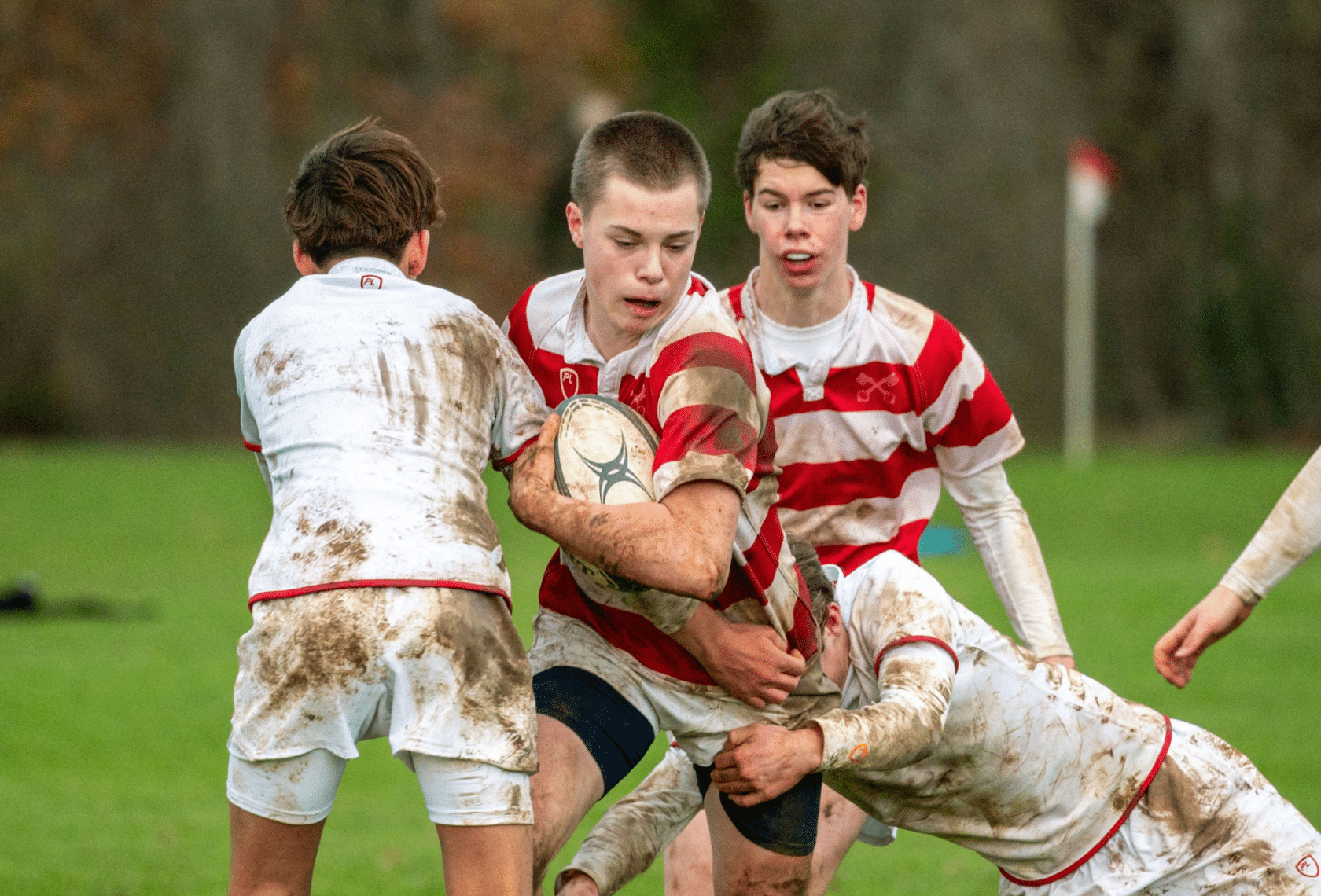

Saturday saw Radley’s rugby teams face Tonbridge School in an array of home and away matches (“Memories for a lifetime for this outstanding group of young men!” writes Douglas (6.2, L) in his Bigside match report). On the same day, The Sunday Times‘s rugby correspondent Stephen Jones published an article celebrating the College’s achievements in the sport, resisting a nationwide decline in participation:
‘The heavy rain had cleared by kick-off time; the clouds had lifted — to reveal a version of rugby heaven. Rugby pitches stretched further than the eye could see, and if you walked a few hundred metres and turned the corner you found… more rugby pitches.
‘One of them had not drained as well as the others and was out of use, but there was action on all the rest. Radley College, a few miles south of Oxford, fielded nearly 450 players last Saturday, their teams playing a total of 22 matches against other schools, most of them in a block fixture against Sherborne. It was a fixture from history, since the two schools first met in 1914.
‘Most of the games were on Radley’s pitches but other Radley teams boarded three 60-seat coaches to play fixtures at Sherborne and also met teams from Bedford School, Berkhamsted and Harrow.
‘On the main pitch, called Big Side, the Radley and Sherborne first XVs played a blistering match to celebrate their past and present but, perhaps equally noteworthy for me, in its way, was the performance of Radley’s fifth XV. You might have expected them to play as if lowly cast-offs, victims of the school’s desire that everyone should play. But the players were fiercely committed, the match was excellent.
‘Rugby union has been left beleaguered by falling numbers in schools and by anxieties about safety. Some of us who have coached in the state-school sector have experienced the difficulties. But to see the game played so well and so joyously, and in such numbers, was ridiculously enjoyable. It was, indeed, joyous. It was evidence that rugby can sometimes replicate its old self — buzzing with energy, and yet safe.
‘Radley is a singular institution. It believes wholeheartedly in rugby as a force for the good — although it does offer the touch rugby option for those who prefer no contact. John Moule, the warden since 2014, told me that when the school is recruiting teachers, to have a strong knowledge of sport — and ability to encourage or to coach it as well as expertise in their primary subject — counts in the favour of candidates.
‘Last weekend, every Radley team had its own coaches drawn from the staff room; every match had staff refereeing — only the first XV game had a referee society official. And there was more than enough rugby expertise afterwards in the well-appointed basement bar where Radley entertained all the opponents’ coaches. The previous warden agreed the boys could have a bar as long as they constructed it largely by themselves.
‘After the games were over, I spoke to Rory (6.2, G), the Radley captain. Honey was a vastly impressive figure in midfield. He was born in Zimbabwe but qualifies to play for Ireland through his mother. He has already played for the Irish Qualified team against three of the Irish provinces. It was his last home game for Radley, and I asked him how vivid the memories would be in his later years.
‘“They would mean the world to me,” Rory said. “It is just a special team and in a special school. It has been a great year — 12 wins, one defeat so far — the best weeks of my life. Everyone gets behind the school, and the culture of rugby is still going strong.”
‘The driving force of the whole operation is Nick Wood. He played 278 games in the front row for Gloucester, one of the least-forgiving roles you could imagine, but he discharged it beautifully. He is an Old Radleian and returned to the school first as the professional rugby coach, but he is now a teacher, the head of rugby, and also administers one of the houses as a tutor. Last week he went to Twickenham to address referees on scrummaging, in light of the South African scrum’s demolition of Ireland and its implications.
‘Does he ever find rugby and school overwhelming? You assumed that he had vast help to arrange all the fixtures, the referees, the buses, and the teams. Not a bit of it. “I do it all myself,” he says.
‘Does he ever get tired of endless rugby and the honest toil? “Not really, to be honest. I forget sometimes that my life is so jam-packed from seven in the morning to 12 at night and then I forget to take stock for a second. But the beauty of being out on the pitches coaching, and also, where the 13 pitches are located — the number of boys that filter past, stop and watch, and just being in the midst of 450-odd kids out there playing rugby, chucking a ball around, sun shining — it’s marvellous.”
And what of the heavy responsibility to deliver rugby safely? “There are very significant external challenges to rugby in terms of perception. You need to find the right level to pitch the challenge as to who you are playing. You want to put yourself into a position where you stand a chance of losing games and our fixture list has continued to get harder deliberately.
“I really believe that it is the one sport where you can know yourself inside and out and where you know your team-mates inside and out. An all-boys’ school looking at the character development of teenagers, exposes both strengths and weaknesses of character. And in a school like ours where you have the schoolmaster/coach model, we have the value of having the schoolmaster on the sideline, who has the opportunity through sport to work on the character with you.”
‘The safety concerns are always real. Radley has the resources to reduce the risks. “At the end of every year we sit with the medical officer, and we have a doctor who sits on the council,” Wood says. “We sit with all the nurses and the lead nurse of the college and go through the injuries, we look at the overall statistics so we are getting the big-picture stuff every year.
‘“I put zero pressure on anyone to win anything, even in a cup match. There is no pressure to leave any player on if there’s any suspicion [of injury]. In the week we hardly do any contact, it is technique, technique, technique and everything is about putting yourself in the right position to make the tackle, to perform the breakdown skills. You are hoping that is enough to protect against the risks that were in the game, and to make sure the risks are never near outweighing the benefits.”
‘There will be reservations about Radley, of course. There will be jealousy about its status and financial power. There is resistance to boys-only schools. There is no question that the boys out there last weekend can be described as privileged, but nor is there doubt about their appetite for the sport.
‘And Radley has a conscience. It runs an enormous partnership programme, linked with the local communities, in which its resources are used to boost sport and life where resources are scarcer.
‘To reveal an interest, when I was coaching Desborough School in Maidenhead, with a large number of willing players but very few resources, Radley stepped in. It sent a coach to us every week, entertained us twice at pre-season camps and, frankly, maximised a team which had a potential. It was a magnificent experience to see the boys improve under the Radley influence and the people we knew at Radley even kept smiling when we beat their second team on Big Side.
‘The partnerships are many and varied. The school provides pupils to help local secondary schools deliver sporting lessons; they run a rowing academy at two local schools; there is the OX14 Learning Partnership, a group of six Abingdon secondary schools, both state and independent, which work together in supporting young people across the town in their education.
‘One of the most significant partnerships is with Broadway Academy, from inner-city Birmingham. Radley has a long relationship with them and has helped with a galaxy of guidance in sport and life. Its director of sport, Naveed Arshad, says: “Importantly, it has had a highly positive and transformative impact on the behaviour, attitudes and engagement of some of the school’s most challenging students, including those previously identified as being at risk of permanent exclusion.” Last Thursday, Broadway’s team came to Radley to play their first rugby match.
‘Radley could not quite put a final gloss on their own season; last week they lost in the semi-finals of the National Schools Cup to Epsom College. No doubt the disappointment was enormous. But the big picture unwavering.
‘Last weekend, drifting away in the dark, you could still hear echoes of the whistles, the cries of commitment, the celebrations of tries, and the post-match banter of the players as they came back in from the far pitches. It was stirring. Rugby does have its problems, but its essential magnificence has never been completely obscured.
‘Last Saturday, south of Oxford, there were 450 votes in favour of the sport.’